


TL;DR
Proxy chaining links multiple proxies together so your request hops from one server to the next before hitting the target site. Each hop only knows the server before and after it, making it much harder to trace the original IP. The trade-off is real: every added hop increases latency and adds a failure point. Chains do not encrypt anything on their own, and for most scraping work, a single rotating proxy beats a chain on both speed and reliability.
What Is Proxy Chaining

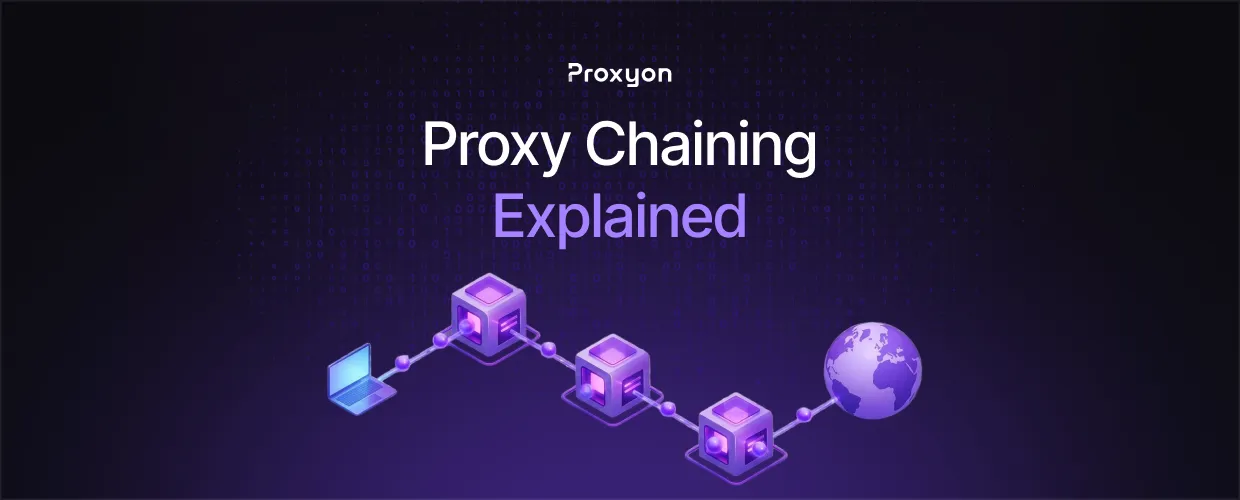
A single proxy puts one server between you and the target. Proxy chaining puts several. Your request goes to proxy A, then proxy B, then proxy C, and only then reaches the destination. The target site sees the IP of the last proxy in the chain.
Each server only knows its direct neighbors. Proxy B sees traffic from A and forwards it to C, but has no view of your real IP or the final destination. This is the same principle Tor is built on, minus the layered encryption that onion routing adds on top.
One thing worth clearing up: this is not the same as API proxy chaining in platforms like Apigee, where one API proxy calls another to reuse logic. This article covers network-level chaining, where the goal is anonymity and routing control.
How a Proxy Chain Works

Most chains mix SOCKS5 and HTTP proxies, with each hop forwarding the connection to the next. SOCKS5 works best here because it forwards raw TCP traffic without touching the payload, which keeps the chain protocol-agnostic.
The most common tool for building chains is proxychains-ng, which intercepts an application's network calls and pushes them through your configured proxy list. A basic config looks like this:
# /etc/proxychains.conf
strict_chain
[ProxyList]
socks5 192.111.10.4 1080 user pass
socks5 10.20.30.40 1080 user pass
http   45.66.77.88 8080
Strict chain mode uses every proxy in order and fails if one goes down. Dynamic chain mode skips dead proxies and keeps the connection alive, which is the safer default for anything running unattended.
Also Read: What is a Backconnect Proxy and How Does It Work
What Proxy Chaining Does Not Do

A chain does not encrypt your traffic. If the request is plain HTTP, every proxy in the chain can read it. Encryption comes from TLS between your client and the destination, not from the chain itself. Claims that chains make you "impossible to hack" are simply wrong.
A chain is also only as trustworthy as its weakest node. Route your traffic through a free public proxy and you have handed your data to an unknown operator, no matter how long the chain is.
When Chaining Makes Sense

Chaining fits a narrow set of jobs. Penetration testers use it to obscure their origin during authorized assessments. Privacy-focused users layer proxies across jurisdictions to complicate attribution.
For web scraping, chaining is usually the wrong tool. Every hop adds latency and multiplies your failure rate. What scrapers actually need is IP diversity, and rotating residential proxies deliver that with a single hop. One endpoint, a fresh IP per request, no chain to babysit.
Speed-sensitive tasks point the same direction. If you need fast, stable connections for automation or bulk requests, datacenter proxies on a direct route will outperform any chain. The keyword here is purpose: chains buy anonymity depth, rotation buys scale, and mixing up the two costs you performance for nothing.
Also Read: IP Rotation: How It Works and Why It Matters for Scraping
FAQ Section

Is proxy chaining the same as using Tor?
No. Tor chains traffic through three relays with layered encryption at each hop. A manual proxy chain routes traffic through your chosen servers but adds no encryption of its own.
Does proxy chaining make me anonymous?
It makes tracing harder, not impossible. Logs at any node, payment trails, and browser fingerprinting can still identify you. Anonymity depends on the whole setup, not just the routing.
How many proxies should I chain?
Two or three at most. Each additional hop adds latency and a failure point while the anonymity gain shrinks. Beyond three, you are paying in speed for almost nothing.
Does proxy chaining slow down my connection?
Yes, always. Every hop adds round-trip time, and your total speed is capped by the slowest proxy in the chain.
Can I mix HTTP and SOCKS5 proxies in one chain?
Yes. Tools like proxychains-ng support mixed chains. Keep SOCKS5 where possible since it forwards raw traffic without modifying it.
Is proxy chaining legal?
The technique itself is legal in most jurisdictions. What matters is what you do through the chain. Unauthorized access stays illegal no matter how many proxies sit in front of it.
Do rotating proxies replace proxy chains?
For scraping and automation, yes. Rotation gives you a new IP per request through a single hop, which covers the main reason most people consider chaining in the first place.
Final Thoughts
Proxy chaining is the right call when you need layered separation between yourself and the destination, and you are willing to pay for it in speed. For scraping, automation, and anything running at scale, a single rotating proxy does the job better with none of the overhead.