


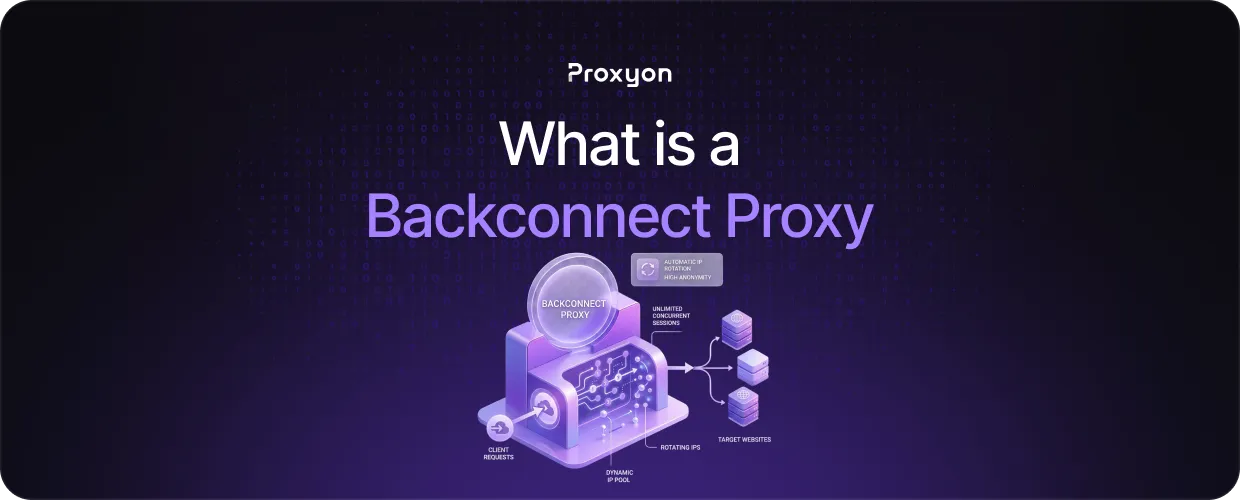
A backconnect proxy sits in front of a large pool of IPs and automatically assigns a new one to each request, all through a single entry point. Instead of managing multiple proxy addresses yourself, you connect to a single gateway, and it handles rotation on the backend. This makes it one of the most practical solutions for large-scale web scraping, SEO monitoring, and any task that requires continuous access to the web without getting blocked.
In this article, we'll explore what backconnect proxies are, how they work under the hood, and when you should use them.
How Backconnect Proxies Work
When you connect to a backconnect proxy, your request hits a gateway server first. That gateway picks an IP from its pool and forwards your request through it. The target website only sees the exit IP, never the gateway, and never you. On the next request, the gateway assigns a different IP automatically.
The rotation works in two ways. Request-based rotation assigns a new IP for every single request, which is the better option for scraping since it makes patterns nearly impossible to detect. Session-based rotation keeps the same IP for a set period, which is useful when you need to stay logged in or maintain a consistent identity across multiple pages.
Most providers, including Proxyon, handle all of this through a single endpoint URL. You configure it once, and the backend does the rest.
Also Read: Residential Proxy vs Datacenter Proxy
Backconnect Proxies vs. Regular Proxies
A regular proxy gives you one IP. Once a website blocks it, you are done unless you manually switch to another one. This works for light, occasional use, but falls apart at any serious scale.
A backconnect proxy gives you access to an entire pool, sometimes millions of IPs, through a single connection point. Blocks become irrelevant because the next request already comes from a different IP. There is no manual intervention, no downtime, and no need to manage a proxy list on your end.
The tradeoff is cost. Backconnect proxies are more expensive than static ones, but for any task that involves large volumes of requests, the reliability is worth it.
When to Use a Backconnect Proxy

Backconnect proxies make sense when your task involves sending a high volume of requests to the same target. Web scraping is the most common use case, especially on sites with aggressive bot detection that would block a static IP within the first few requests.
They are also a solid choice for SEO monitoring, where you need to check rankings across different locations without getting flagged, and ad verification, which requires checking ads from multiple geographies without triggering filters.
If you are only making occasional requests or working with a target that has no real bot protection, a static proxy is cheaper and gets the job done. Backconnect proxies are the right tool when scale, consistency, and avoiding blocks are all required at the same time.
Also Read: What is an Anonymous Proxy
Final Thoughts
Backconnect proxies solve IP blocking by cycling through a large pool of IPs automatically, all from a single endpoint. For scraping, SEO monitoring, or ad verification at scale, they are the most reliable option available. Residential proxies start at $1.75/GB with no subscription required. Deposit $5 and start at Proxyon.