


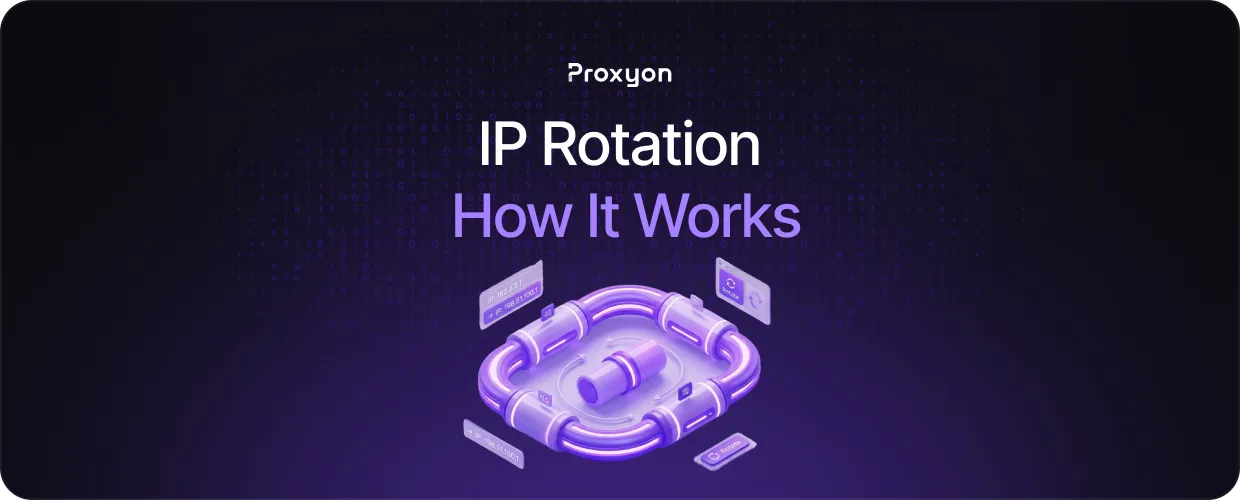
Most scraping operations fail not because of bad code, but because the target website blocks the IP after too many requests from the same source. IP rotation solves this by constantly switching the IP your requests come from, so the server never gets the chance to flag you.
In this article, we'll explore what IP rotation is, how it works, and why it matters for scraping at scale.
How IP Rotation Works
Each request your scraper sends carries your IP address, and websites use that to track and block suspicious activity. IP rotation assigns a different IP to each request, or after a set time interval, so the target never sees enough repeated traffic from one source to trigger a block.
This is handled through a proxy pool, a large collection of IPs that the service cycles through on your behalf. You point your scraper to a single endpoint, and the provider handles the switching automatically.
Rotation can be request-based, where each request gets a fresh IP, or session-based, where the same IP is kept across a set number of requests before switching. Request-based works best for large-scale scraping, while session-based is useful when the target requires IP consistency across consecutive pages, like a login flow or multi-step checkout.
Also Read: What Are Rotating Proxies? How They Work
Why IP Rotation Matters for Scraping
Without IP rotation, your scraper will eventually get blocked. Some sites do it after a few dozen requests, others after a few hundred. Either way, your scraper stops, and you lose access to the data.
IP rotation spreads your requests across many different IPs, making your traffic blend in with normal user behavior. This lets you scrape at scale without constantly rewriting logic to work around bans.
It also matters for data accuracy. Websites often serve different content based on location or user profile. Rotating through residential proxies tied to real locations gives you access to data as it actually appears to real users, not a filtered version of it.
Choosing the Right Rotation Strategy

The right strategy depends on what you are scraping and how protected the target is.
For most jobs, datacenter proxies with request-based rotation are enough, fast, affordable, and effective on sites without aggressive bot detection. If the target actively filters datacenter traffic, residential proxies are the better choice since their IPs come from real ISP-assigned addresses and are much harder to flag.
Session-based rotation makes sense when switching IPs mid-session causes inconsistent data or resets your progress. The most common mistake is rotating too aggressively without pacing requests. Rate limiting is something every scraper has to account for, and combining rotation with reasonable request intervals is what actually keeps your scraper running long-term.
Also Read: Residential vs Datacenter Proxies
Final Thoughts
Match your proxy type to your target, pick the right rotation strategy, and keep your request pace reasonable. Proxyon offers both residential and datacenter rotating proxies with no subscription required. Start at proxyon.