


TL;DR
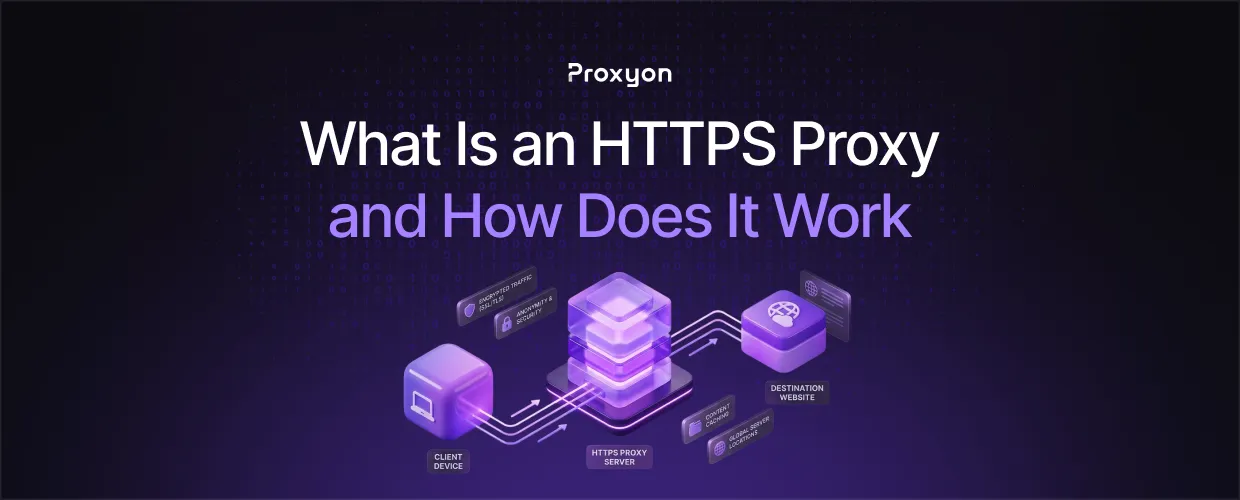
An HTTPS proxy forwards encrypted traffic through a tunnel opened with the CONNECT method. The target site sees the proxy's IP, and TLS encryption stays intact end to end.
Every serious website today runs on HTTPS, so your proxy has to handle encrypted traffic correctly. In this article, we'll explore what an HTTPS proxy is, how tunneling works, how it compares to HTTP and SOCKS5 proxies, and how to use one in practice.
What Is an HTTPS Proxy

An HTTPS proxy is an intermediary server that handles traffic to sites running over HTTPS, the encrypted version of HTTP. One thing worth knowing: an SSL proxy usually decrypts traffic for inspection, while a true HTTPS proxy never decrypts anything.
How an HTTPS Proxy Works

The core mechanism is HTTP tunneling:
- Your client sends a CONNECT request naming the target host and port, usually 443.
- The proxy opens a TCP connection to that host and returns 200 Connection Established.
- Your client performs the TLS handshake with the target through the tunnel.
- All further traffic passes through as an encrypted byte stream.
The proxy never holds the encryption keys. It sees the host you connected to, but not your credentials or content.
Also Read: Sticky Sessions vs Rotating Proxies
What HTTPS Proxies Are Used For

Web scraping is the biggest use case, with scrapers routing requests through residential proxies to avoid IP blocks. Geo-testing and privacy come next: view content as a local user while your real IP stays hidden. Where speed beats stealth, datacenter proxies tunnel HTTPS at higher throughput and lower cost.
Also Read: How to Use a Proxy Server on Any Device (2026)
How to Use an HTTPS Proxy in Python

With Python requests, map both schemes to one endpoint:
import requests

proxies = {
    "http": "http://user:pass@gateway.example.com:8000",
    "https": "http://user:pass@gateway.example.com:8000"
}

response = requests.get("https://httpbin.org/ip", proxies=proxies)
print(response.text)
The library handles the CONNECT request and handshake automatically. A 407 error means your credentials need fixing.
FAQ Section

Does an HTTPS proxy encrypt my traffic?
Not by itself. Encryption comes from TLS between you and the target. The proxy just preserves it.
Is an HTTPS proxy the same as a VPN?
No. A VPN encrypts everything system-wide, while a proxy works per request and rotates IPs easily.
Can an HTTPS proxy see what I'm doing?
It sees the hostname and traffic volume, but not the content.
Do I need a special proxy for HTTPS sites?
No. Any proxy supporting the CONNECT method carries HTTPS traffic, and virtually all commercial proxies do.
What port does an HTTPS proxy use?
The target is almost always port 443, while the proxy itself listens on whatever port the provider assigns, commonly 8000, 8080, or 3128.
Are free HTTPS proxies safe?
No. Free proxies are often overloaded, short-lived, or run by operators who log your metadata, so avoid them for anything serious.
Can websites detect that I'm using an HTTPS proxy?
They cannot see inside the tunnel, but they can check the IP reputation. Datacenter IPs get flagged more often than residential ones.
Final Thoughts
An HTTPS proxy is the default choice for almost anything on the modern web, since nearly every site runs encrypted. It hides your IP and keeps TLS intact with every major HTTP client. Proxyon offers residential, datacenter, and IPv6 proxies with full HTTPS support, so you can start small and scale as needed.