


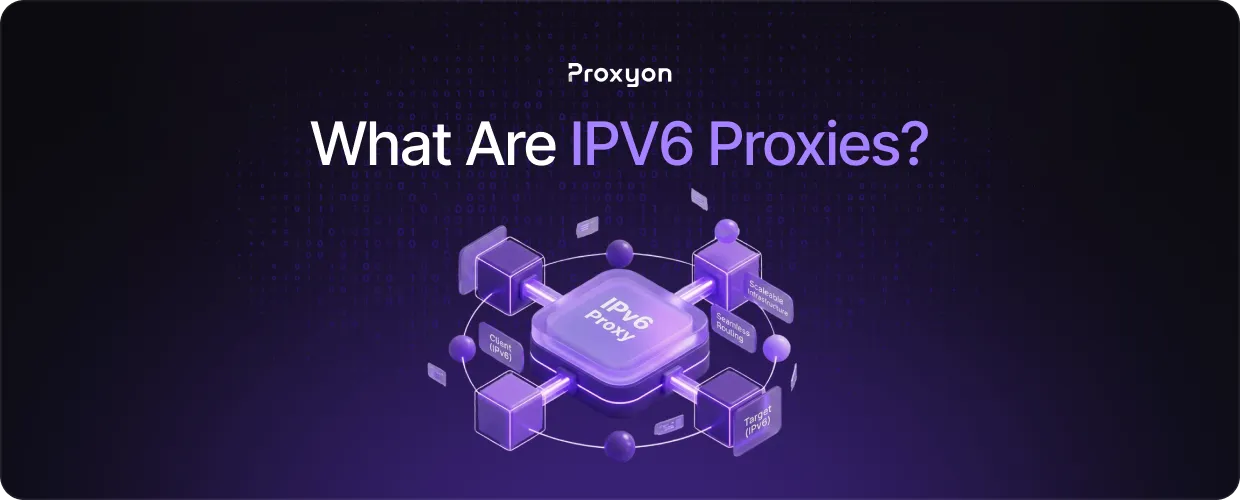
The Internet is running out of IPv4 addresses. ISPs and data centers have been shifting to IPv6 for years now, and proxy providers followed. IPv6 proxies are faster, cheaper, and available in massive quantities compared to IPv4, but they come with real limitations that make them a poor fit for certain tasks.
In this article, we'll explore what IPv6 proxies are, how they work, and when it actually makes sense to use them.
How IPv6 Proxies Work
IPv6 proxies work the same way any proxy does. Your request goes through an intermediary server before it reaches the target website, masking your real IP. The difference is that the IP assigned to you follows the IPv6 format, which looks something like 2001:0db8:85a3:0000:0000:8a2e:0370:7334 instead of the standard four-number IPv4 format you're used to seeing.
Because there are 340 trillion possible IPv6 addresses, providers can generate them in bulk at almost no cost. This makes IPv6 proxies significantly cheaper than residential or even datacenter IPv4 proxies. Most providers assign you a fresh IPv6 address per request or per session, depending on how you configure it.
The catch is that not every website supports IPv6 yet. If the target site only runs on IPv4, your request either fails or gets routed back through IPv4 anyway, which defeats the purpose.
Also Read: Rotating Residential Proxies Explained
IPv6 Proxies vs IPv4 Proxies
The main difference comes down to price and compatibility. IPv6 proxies are much cheaper because addresses are virtually unlimited, while IPv4 addresses are scarce and cost more to source. If you are running a high-volume operation and your targets support IPv6, you can cut your proxy costs significantly by going with IPv6 proxies.
On the detection side, IPv6 proxies are a mixed bag. Some websites treat IPv6 traffic with more suspicion simply because it is less common, which can work against you. Others have no filtering in place for IPv6 at all, which means you can fly under the radar more easily than you would with a datacenter IPv4 proxy.
Speed is roughly the same between the two. The protocol itself does not make one faster than the other in any meaningful way. What matters more is the provider's infrastructure and how close their servers are to your target.
The bottom line is that IPv4 still has broader compatibility, but IPv6 is the more cost-efficient option when it works for your use case.
What Can You Use IPv6 Proxies For
IPv6 proxies are a good fit for tasks where you need volume at a low cost, and your targets are known to support IPv6. SEO monitoring and rank trackers are a common use case since most search engines support IPv6, and you are often sending thousands of requests at a time, so the cost savings add up fast.
Social media automation is another area where IPv6 proxies get used, though results vary depending on the platform. Some platforms handle IPv6 traffic without issues; others are more likely to flag it.
Ad verification and data aggregation on IPv6-compatible sites also work well. If you are pulling large amounts of data from sites that support IPv6, you get the same job done at a fraction of the cost of residential proxies.
Where IPv6 proxies fall short is anything that requires accessing IPv4-only sites or targets with serious bot detection. For those cases, you are better off with residential or mobile proxies. IPv6 is not a replacement for every use case; it is a cost-efficient option for the right ones.
Also Read: The Smart Guide to Buying Proxies
Final Thoughts
IPv6 proxies make sense when you need volume at a low cost, and your targets support IPv6. They are not a replacement for residential or mobile proxies, just a cheaper option for the right use case.