


TL;DR
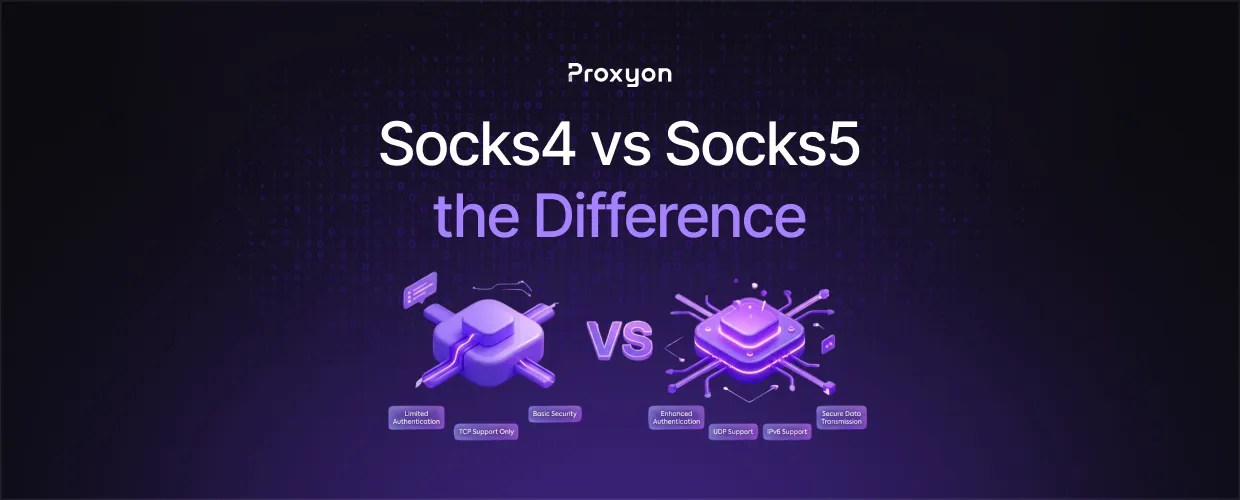
SOCKS4 carries TCP only, has no authentication, and is limited to IPv4. SOCKS5 adds UDP support, username and password authentication, IPv6, and proxy-side DNS resolution. Neither one encrypts your traffic. For almost every modern use case, pick SOCKS5.
A SOCKS proxy sits between your device and the internet and forwards any kind of traffic, and the differences between its two versions decide which one fits your setup. In this article, we'll explore how each protocol works, where they differ, and which one you should actually use.
What Is SOCKS4

SOCKS4 is the older version. It routes TCP connections between a client and a server, and nothing more. With no authentication built in, anyone who knows the proxy's IP and port can use it.
It also expects your machine to perform the DNS lookup locally, then hand the proxy a raw IP address. That leaks your DNS queries to your local network, which matters if privacy is why you are using a proxy at all.
What Is SOCKS5

SOCKS5 is the current standard, defined in RFC 1928. It carries both TCP and UDP traffic, which opens it up to streaming, gaming, VoIP, and torrenting.
It adds access control through username and password authentication, which is why every serious provider, including residential proxies sold today, runs on SOCKS5. It also resolves DNS on the proxy side, keeping your lookups off your local network, and supports IPv6, while SOCKS4 is locked to IPv4.
Also Read: How to Use a Proxy Server on Any Device (2026)
SOCKS4 vs SOCKS5: The Key Differences
Both protocols handle TCP, but that is where the overlap ends. SOCKS5 adds UDP, authentication, proxy-side DNS, and IPv6. SOCKS4 offers none of that.
One thing worth knowing: neither protocol encrypts your traffic. Security comes from HTTPS or an SSH tunnel. Plenty of articles claim SOCKS5 is "encrypted", and that claim is wrong.
Which One Should You Use
In nearly every case, SOCKS5. If your tool needs UDP, authentication, or IPv6, SOCKS4 is not even an option. If you are scraping or automating at scale, SOCKS5 paired with datacenter proxies gives you speed plus proper access control.
The only reason to touch SOCKS4 in 2026 is legacy software that supports nothing else.
Also Read: Sticky Sessions vs Rotating Proxies
FAQ Section

Is SOCKS5 faster than SOCKS4?
Not by itself. Speed depends on the proxy server and network, not the protocol.
Does SOCKS5 encrypt my traffic?
No. Encryption comes from HTTPS, TLS, or an SSH tunnel layered on top.
Can I use SOCKS4 for torrenting?
Not reliably. Torrent clients depend on UDP, and SOCKS4 only handles TCP.
Is SOCKS5 better than an HTTP proxy?
For non-browser traffic, yes, because it carries any protocol.
Can I use SOCKS5 for web scraping?
Yes. SOCKS5 works with Python requests, Scrapy, Playwright, and most scraping tools.
Is SOCKS4 still safe to use?
It works, but no authentication and local DNS lookups make it a weak choice for privacy.
Does SOCKS5 support IPv6?
Yes. SOCKS5 handles both IPv4 and IPv6, while SOCKS4 is limited to IPv4.
Final Thoughts
SOCKS5 wins in every category that matters. It handles UDP, supports authentication, resolves DNS on the proxy side, and works with IPv6, while SOCKS4 is a bare TCP router with no access control. Pick SOCKS4 only when a legacy tool forces your hand.