


TL;DR
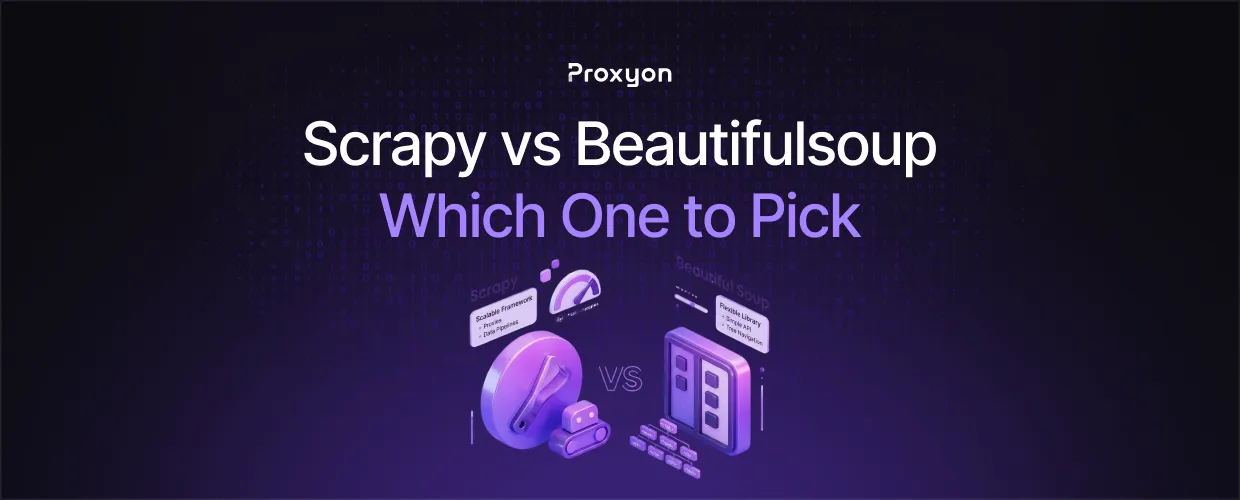
Scrapy handles requests, crawling, concurrency, and data pipelines out of the box, which makes it the right pick for large or ongoing scraping projects. BeautifulSoup only parses HTML, so it pairs with a client like requests and works best for small scripts and one-off jobs. If you need speed and scale, go with Scrapy. If you need simplicity, go with BeautifulSoup.
The Scrapy vs BeautifulSoup debate comes up in almost every Python scraping project, and most comparisons get the framing wrong. These are not two versions of the same tool. One is a full framework, the other is a single library that handles exactly one job. In this article, we'll explore what each tool actually does, where the real differences are, and how to decide which one fits your project.
What BeautifulSoup Actually Does
BeautifulSoup is a Python library that parses HTML and XML into a searchable tree. That is the entire job. It never sends a request, never downloads a page, and never manages a crawl. You pair it with an HTTP client like requests, feed it the raw HTML, and it lets you pull out elements by tag, class, or CSS selector.
This is why comparing BeautifulSoup to Scrapy directly is misleading. The honest comparison is requests plus BeautifulSoup versus Scrapy. The library itself is forgiving with broken markup, easy to learn, and quick to drop into any script. Real Python's Beautiful Soup tutorial shows a full working scraper in one short file.
The downside is that everything around the parsing is on you. Retries, concurrency, rate limiting, and data export all have to be built by hand.
What Scrapy Actually Does
Scrapy is a framework, not a library. It sends requests, follows links, parses responses, retries failures, and exports data through built-in pipelines. It runs asynchronously by default, so it fires many requests at once instead of waiting on each one. For crawls that cover thousands of pages, this is the difference between minutes and hours.
One thing worth knowing: Scrapy does not use BeautifulSoup at all. It ships with its own parser called parsel, which supports both CSS selectors and XPath. BeautifulSoup has no XPath support, so complex or deeply nested structures are often easier to target in Scrapy. You can check the current release on PyPI.
The trade-off is the learning curve. Scrapy expects a project structure, spiders, and settings files. For a script that grabs one page, that setup is overkill.
Also Read: Plug Proxyon Into Scrapy
Proxies and Getting Blocked
Neither tool protects you from bans. Any scraper that sends repeated requests from one IP will get rate limited or blocked eventually. Scrapy has middleware built for proxy rotation, so plugging residential proxies into a spider is a settings change, not a rewrite. With requests and BeautifulSoup, you pass a proxy dictionary on every call, which works fine for small jobs on datacenter proxies but gets messy once you add rotation and retries yourself.
Also Read: How to Set Up Rotating Proxies for Web Scraping (2026)
Which One Should You Pick
The decision comes down to what you are actually trying to do. A few pages, a quick script, or a beginner project points to BeautifulSoup. Thousands of pages, recurring crawls, or anything running in production points to Scrapy. Migration between them is also easier than it sounds, since both support CSS selectors, so starting small with BeautifulSoup and moving to Scrapy later costs very little. And if you ever need both, BeautifulSoup can run inside Scrapy callbacks to handle badly broken HTML.
FAQ Section
Is Scrapy faster than BeautifulSoup?
Yes, at scale. Scrapy sends requests asynchronously, while a typical requests plus BeautifulSoup script processes one page at a time.
Does Scrapy use BeautifulSoup?
No. Scrapy uses its own parsing library called parsel, though you can import BeautifulSoup inside a Scrapy spider if you prefer its syntax.
Can BeautifulSoup scrape a website on its own?
No. It only parses HTML that something else downloaded. You need an HTTP client like requests to fetch the pages first.
Which one is better for beginners?
BeautifulSoup. You can write a working scraper in a few lines without learning a project structure or framework concepts.
Does BeautifulSoup support XPath?
No. BeautifulSoup only supports its own search methods and CSS selectors. Scrapy's parsel supports both CSS selectors and XPath.
Can Scrapy handle JavaScript-rendered pages?
Not by default. Neither can BeautifulSoup. Both need a rendering layer like Playwright or Splash for JavaScript-heavy sites.
Do I need proxies with Scrapy or BeautifulSoup?
Yes, for anything beyond a handful of requests. Both tools expose your real IP, and repeated requests from one address get blocked quickly.
Final Thoughts
BeautifulSoup is the right call for small scripts and quick extraction jobs, while Scrapy is built for crawls that need speed, structure, and scale. The two are not rivals so much as tools for different project sizes, and moving from one to the other is cheap since both speak CSS selectors. Whichever you pick, pair it with reliable proxies before the bans start.