


TL;DR
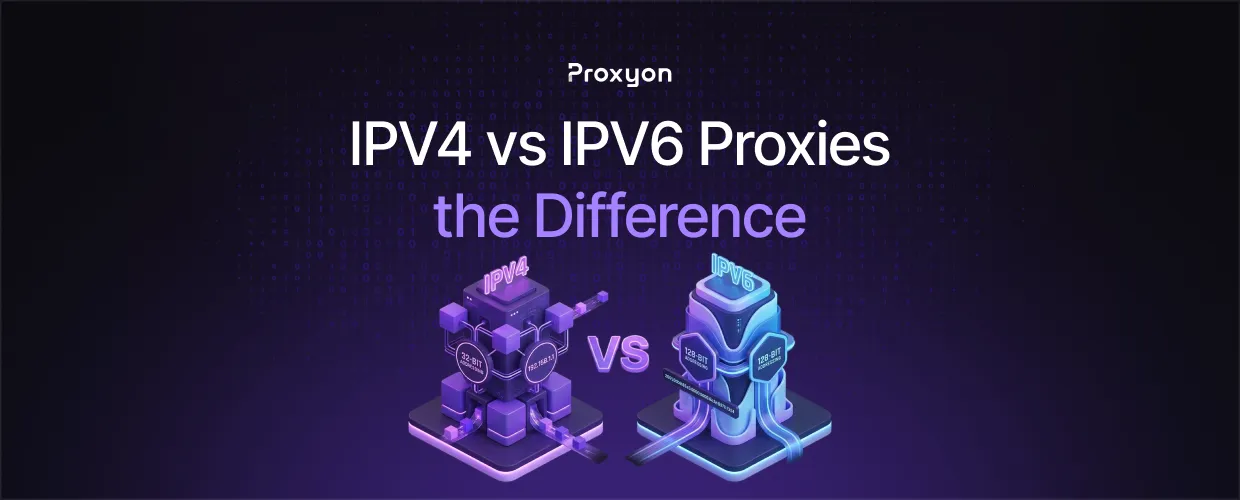
IPv4 is the older protocol, with 4.3 billion addresses, all of which are already in use. IPv6 is the newer one with a practically unlimited supply. That difference in supply is why IPv4 proxies cost more and IPv6 proxies cost almost nothing. IPv4 works everywhere; IPv6 works on fewer sites but scales far cheaper. The right pick comes down to what your target sites support.
What Is IPv4
IPv4 is the fourth version of the Internet Protocol and still carries most of the world's traffic. An IPv4 address is a 32-bit number written in four blocks separated by dots, like 192.168.1.1. That format allows around 4.3 billion unique addresses, and the internet ran out of fresh ones years ago.
The shortage is the whole story with IPv4. Every address in use today is recycled, leased, or shared through NAT, a technique that lets multiple devices sit behind one public IP. Scarcity drives up the price of every IPv4 address, and that cost flows straight into proxy pricing.
What Is IPv6
IPv6 is the replacement. Addresses are 128-bit and written in hexadecimal, like 2001:0db8:85a3::8a2e:0370:7334. The total supply is 340 undecillion addresses, which is enough to give every device on Earth trillions of its own. The full specification lives in RFC 8200 if you want the technical details.
Because supply is effectively infinite, IPv6 addresses are cheap. Providers can hand out entire subnets for the price of a single IPv4 address. That makes IPv6 the budget option for anything that needs thousands of IPs at once.
The Key Differences That Matter
The address format is the visible difference, but the practical ones are supply, cost, and adoption. IPv4 is scarce and expensive, IPv6 is abundant and cheap. IPv4 is accepted by virtually every website, while Google's adoption data shows less than half of global traffic reaches it over IPv6, meaning plenty of sites still don't answer IPv6 requests at all.
One thing worth knowing: IPv6 is not automatically faster or more secure. Speed depends on routing and your provider, not the protocol version. And the encryption claim you see repeated online is misleading, since IPSec is optional on both versions.
IPv4 vs IPv6 for Proxies
This is where the difference gets real. IPv4 proxies, like standard datacenter proxies, work on every target site without exception. They cost more per IP, but you never have to think about compatibility.
Also Read: Sticky Sessions vs Rotating Proxies
IPv6 datacenter proxies flip the trade-off. They are a fraction of the cost, and because subnets are massive, you can rotate through huge pools without repeating an IP. The downside is that your target must support IPv6. Major platforms like Google and Facebook do, but many smaller sites still don't.
Which One Should You Use
Check your target first. If the site resolves over IPv6, take the cheaper option and scale your pool for a fraction of the IPv4 price. If it doesn't, IPv4 is your only choice, and no discount changes that.
For mixed workloads, run both. Route IPv6-compatible targets through IPv6 pools and keep IPv4 for everything else. Proxyon offers IPv6 datacenter proxies from $0.25/IP and IPv4 datacenter proxies from $0.30/IP, so splitting traffic between the two is cheap to test.
Also Read: How to Use a Proxy Server on Any Device (2026)
FAQ Section

Which one is better, IPv4 or IPv6?
Neither is universally better. IPv4 wins on compatibility, IPv6 wins on cost and address supply. For proxies, the deciding factor is whether your target sites accept IPv6 traffic.
Does IPv6 make internet faster?
Not by itself. Speed depends on routing quality and your provider's infrastructure. Some networks route IPv6 more efficiently, others don't, so any difference you notice comes from the network, not the protocol.
Should I use IPv6 at home?
Yes, if your ISP supports it. Most modern routers run dual stack, meaning both versions work at the same time, so enabling IPv6 costs you nothing and prepares you for sites that prefer it.
Is it good to prefer IPv4 over IPv6?
Only when compatibility matters more than cost. IPv4 reaches every site, so it's the safe default. If your targets support IPv6, preferring IPv4 just means paying more for the same result.
Is 8.8.8.8 DNS IPv4 or IPv6?
8.8.8.8 is Google's IPv4 DNS address. The IPv6 equivalent is 2001:4860:4860::8888. Both point to the same resolver service.
Is IPv6 better for gaming?
It can be. IPv6 removes NAT, which gives your device a direct connection and can reduce matchmaking issues in some games. Latency itself stays roughly the same on most networks.
Does 1.1.1.1 work on IPv6?
The address 1.1.1.1 itself is IPv4, but Cloudflare's resolver fully supports IPv6 through 2606:4700:4700::1111. You can run both at once on a dual stack connection.
Is IPv6 slower than IPv4?
No. In most measurements the two perform within a few milliseconds of each other. On well-configured networks IPv6 is sometimes slightly faster because traffic skips NAT processing.
What happens if I change IPv4 to IPv6?
Nothing breaks if your network runs dual stack, since IPv4 stays active alongside IPv6. If you force IPv6 only, sites that don't support it become unreachable, which is why most setups keep both enabled.
Final Thoughts
IPv4 and IPv6 solve the same problem with very different economics. IPv4 costs more because the addresses ran out, IPv6 costs almost nothing because they never will. For proxies, check what your targets support and let that decide, not the price tag alone.