


When you need to hide your IP or bypass restrictions, two tools come up every time: proxies and VPNs. Most people use them interchangeably, but they work differently and are built for different use cases. Picking the wrong one means slower speeds, weaker privacy, or getting blocked anyway.
In this article, we'll explore exactly how each one works, where each one wins, and which one you should actually be using.
How Proxies and VPNs Actually Work

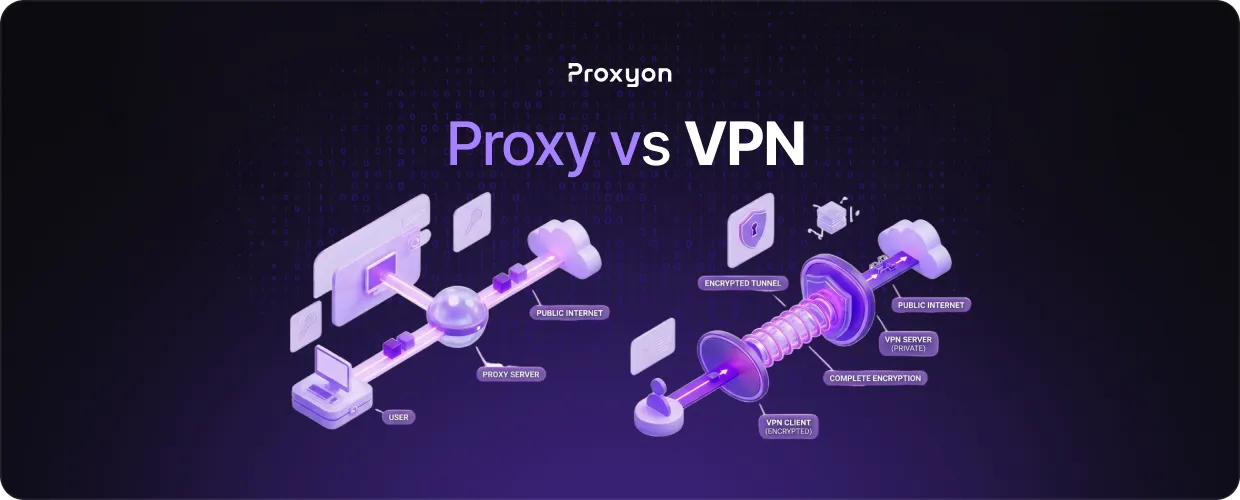
A proxy acts as a middleman between you and the website you're visiting. When you send a request, it goes through the proxy server first, which replaces your IP with its own before forwarding it to the target. The website sees the proxy's IP, not yours. That's essentially all it does: it reroutes your traffic at the application level, meaning it only covers the specific app or browser you configure it on.
A VPN works at the network level, meaning it covers all traffic coming from your device. It creates an encrypted tunnel between your device and a VPN server, then routes everything through it. Every app, every browser, every connection goes through that tunnel. On top of rerouting your IP, it also encrypts your data, so anyone intercepting your traffic sees nothing useful.
Also Read: How to Scrape LinkedIn Jobs With Python
Key Differences: Speed, Privacy, and Use Cases

Proxies are faster because they do less. There's no encryption overhead, so requests go through quickly. This makes them the better choice for high-volume tasks like web scraping, SEO research, and ad verification, where speed and scale matter more than privacy.
VPNs are slightly slower because encrypting and decrypting traffic takes processing power. The tradeoff is that your data is protected end-to-end, which matters when you're on public Wi-Fi, accessing sensitive accounts, or trying to stay private from your ISP.
On the privacy side, proxies don't encrypt anything. If someone intercepts your traffic, it's readable. They're not built for privacy; they're built for IP rotation and access. VPNs are the opposite; the encryption is the whole point.
For use cases, proxies are the right tool for automation, large-scale data collection, and bypassing geo-restrictions on specific platforms. VPNs are better for general browsing privacy, secure remote access, and protecting your connection on untrusted networks.
Which One Should You Use?
It comes down to what you're actually trying to do. If you're running scrapers, collecting data at scale, or doing SEO research, use a proxy. You need speed and IP rotation, not encryption. A VPN would just slow you down without adding anything useful for that kind of work.
If you're browsing privately, accessing sensitive accounts, or connecting from a public network, use a VPN. The encryption matters there, and you're not doing anything that requires rotating IPs or high request volume.
Some people use both at the same time, a proxy for their scraping tools and a VPN for everything else running on the same machine. That's a reasonable setup if your work requires both. But if you're trying to pick one, match the tool to the job. Proxies are built for automation and scale; VPNs are built for privacy and security.
Also Read: API-Centric Proxy Features for Developers
Final Thoughts
Proxies and VPNs solve different problems. Proxies are for speed, scale, and IP rotation. VPNs are for encryption and privacy. Match the tool to the task, and you'll get the results you're after.