


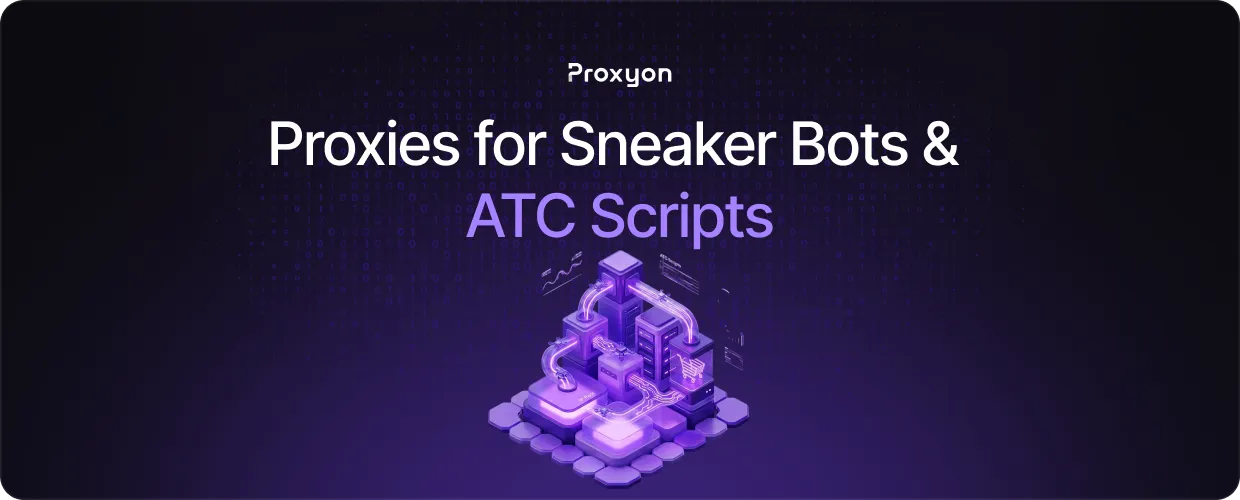
Sneaker botting comes down to speed and scale. You need to send hundreds of requests to a retailer's site in seconds, and if those requests all come from the same IP address, you get flagged and banned before the drop even starts. Rotating proxies solve this by cycling your traffic through a pool of IPs, making each request appear to come from a different user. Without them, even the best ATC script is useless on any major release.
In this article, we'll explore how proxies work with sneaker bots and ATC scripts, which proxy types hold up on Nike, Adidas, and other protected sites, and how to configure residential proxies to maximize your success rate on drops.
Why Proxies Are Non-Negotiable for Sneaker Bots
When a drop goes live, retailers like Nike and Adidas are specifically looking for traffic that doesn't match normal human behavior. Multiple requests from the same IP in a short window is the clearest signal, and the moment your bot triggers it, that IP gets blocked regardless of how good your script is.
Proxies distribute your requests across a large pool of IPs, so each request appears to come from a separate user. Residential proxies assign your bot real ISP-issued IPs, which are the hardest for retailers to fingerprint. Datacenter IPs, on the other hand, are easier to detect and tend to get blocked on high-demand drops. Response time also matters since a slow proxy adds latency that, on a limited drop, can be the difference between a successful checkout and an out-of-stock page.
Also Read: What Are Rotating Proxies? How They Work
Which Proxy Type Works Best for Sneaker Copping
Residential proxies are the standard for major retailers. Nike, Adidas, and Footlocker run aggressive bot detection that specifically targets datacenter traffic, and residential IPs pass that check because they come from real ISPs. Proxyon's pool is large enough to avoid IP overlap across tasks, which matters on high task counts.
Datacenter proxies hold up on smaller boutique sites or raffles without Akamai or Datadome protection, but will get you banned on a SNKRS or Yeezy drop before you reach checkout. Mobile proxies are the hardest to block but rarely worth the cost since residential proxies already cover most scenarios.
How to Set Up Proxies with Your ATC Script
Proxyon gives you a single rotating endpoint, so there's no static list to manage. Point your bot at it, and rotation happens automatically per request. Most major bots like NSB, Kodai, and Wrath have a dedicated proxy import field where you paste it directly using the standard host:port:user:pass format.
For checkout flows, sticky sessions are worth enabling since switching IPs mid-session can trigger extra verification steps. Proxyon supports both rotating and sticky modes. Also, avoid overloading your endpoint with more concurrent tasks than your pool supports, since IP reuse defeats the point of rotating proxies on a competitive drop.
Also Read: How to Bypass Cloudflare Bot Detection With Proxies
Final Thoughts
Residential proxies are the right call for most drops. Proxyon's pool gives you the detection resistance you need without overpaying for mobile. At $1.75/GB with no subscription, deposit $5 and have proxies running in your bot in minutes at Proxyon.