

TL;DR
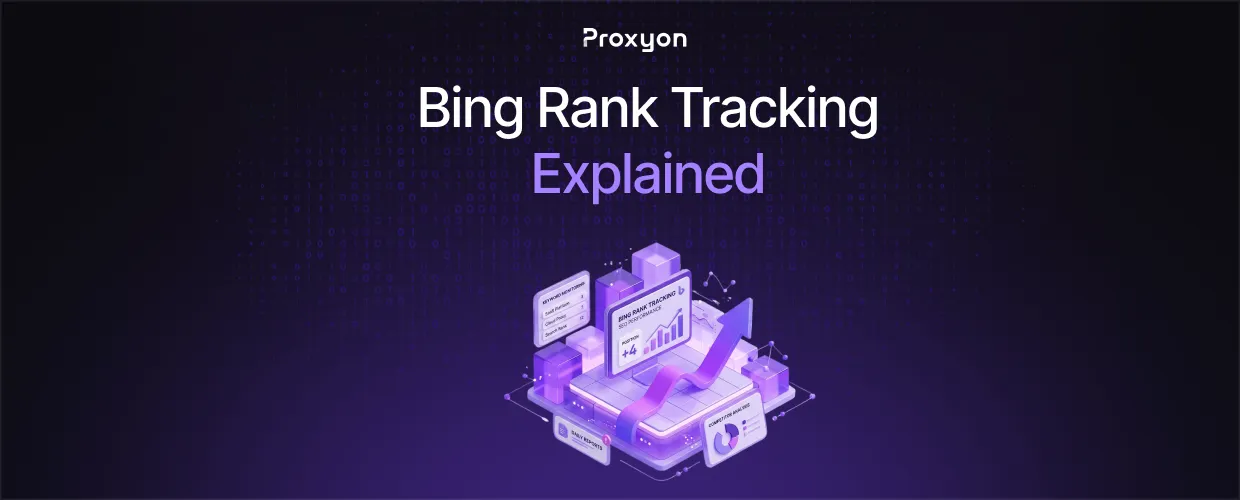
A Bing rank tracker checks where a page lands in Bing's search results for a given keyword, tracked over time. It sounds simple until you try to automate it at scale.
Why Bing Rank Tracking Got Harder in 2025
Microsoft retired the Bing Search APIs on August 11, 2025, shutting down every existing instance with no new signups allowed. The retirement covered all standard resource tiers, confirmed by Search Engine Roundtable at the time. That left developers with one real option for pulling live ranking data: scraping the actual search results page.
Scraping Bing directly means sending automated requests that look like a normal browser. Bing does not treat that kindly at volume. Send too many queries from one IP and you get CAPTCHAs, then blocks.
How Bing Rank Trackers Work
A working tracker sends a search query, renders the results page, and parses position data for your target URL. Do this for one keyword and it is trivial. Do it for a few thousand keywords a day and your IP gets flagged fast.
The fix is the same one scrapers have used for years: route each request through a different IP so no single address sends enough volume to trip Bing's detection. Residential IPs work best here because they carry the same trust signal as a real household connection, unlike datacenter ranges that get fingerprinted quickly.
Also Read: What Is Geo-Targeting With Residential Proxies
Why Proxies Matter More

Rankings also shift by location. Bing personalizes and geo-restricts results, so a rank check from a US IP and one from a UK IP can return different orders entirely. If your tracker needs country or city-level accuracy, the proxy pool matters as much as the scraping code.
Residential proxies give you that control. You can request an exit IP from the exact country or city you're tracking, so the data reflects what a real searcher in that location sees. If cost is a bigger concern than success rate for your target, datacenter proxies are a cheaper way to scale a tracker across many keywords and locations.
For teams that still rely on Bing's own numbers, Bing Webmaster Tools remains useful as a baseline. It just does not give you competitor visibility or on-demand spot checks, which is why most tracking setups pair it with a scraper.
Also Read: Everything You Need To Know About School Proxy
FAQ Section
Is scraping Bing rankings legal?
Scraping publicly available search results is common practice, but you should follow Bing's terms of service and avoid overwhelming their servers with request volume.
Why did Bing rank trackers change in 2025?
Microsoft shut down the Bing Search APIs on August 11, 2025, cutting off programmatic access for all but its largest existing partners. Most tools moved to scraping as a result.
Do I need residential proxies for Bing rank tracking?
For small, occasional checks, no. For daily tracking across many keywords or locations, yes. Residential IPs avoid the blocks that datacenter IPs run into at volume.
Final Thoughts
Building a Bing rank tracker in 2026 comes down to two things: a scraper that parses positions correctly, and a proxy pool that keeps your requests looking like real searches. Skip the proxy layer and you'll hit blocks before you get useful data.