

TL;DR
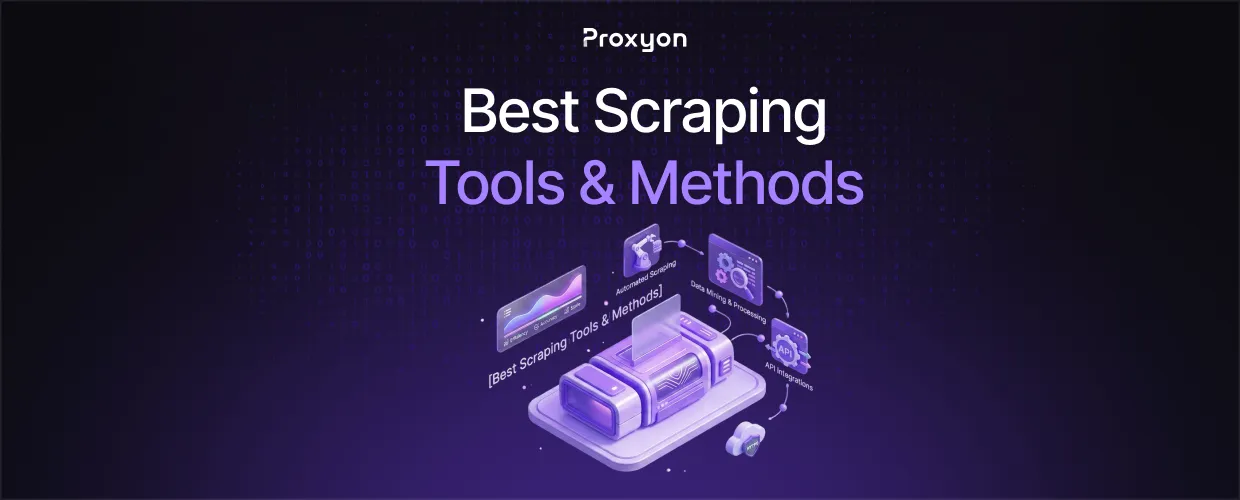
A scraping stack is the combination of a tool that extracts data and a method that gets past blocks. Pick the wrong pair and you spend more time debugging CAPTCHAs than collecting data. Here is what actually works in 2026, and when to reach for each option.
No-Code Tools
Octoparse and Web Scraper let you point, click, and extract without writing a line of code. Octoparse runs in the cloud and handles pagination and login walls. Web Scraper is a browser extension, good for quick one-off jobs but limited on scale. The downside is control. You are working inside someone else's UI, and complex logic gets awkward fast.
Code-First Frameworks
Scrapy remains the default for large, custom scraping jobs in Python. It is fast, async by design, and gives you full control over requests and parsing. For JavaScript-heavy sites, headless browsers like Playwright and Puppeteer render the page first, then extract. This matters more than it sounds: static HTML fetchers miss anything loaded by JS.
Managed Scraping APIs
ScraperAPI and similar services bundle proxy rotation, JS rendering, and CAPTCHA handling into one API call. The trade-off is cost per request versus time saved building that infrastructure yourself. Comes down to what you are actually trying to do: prototype fast, or own the stack long-term.
The Method That Ties It Together: Proxies
None of the above works reliably without IP rotation. Sites block by IP after a handful of requests, regardless of how clean your code is. Residential proxies route through real household IPs and are the right call for sites with anti-bot checks. Datacenter proxies are faster and cheaper, and work fine on targets without aggressive detection.
How the Options Compare
Web Scraper, the browser extension, needs no coding and suits one-off, small jobs, but scale is low and it costs nothing to start. Octoparse also needs no coding and fits recurring jobs run by non-dev teams, with medium scale and a free tier plus paid plans above it.
Scrapy requires coding but handles custom, large-scale pipelines at high scale, and it is free since it is open source. Playwright and Puppeteer also require coding, are built for JS-rendered and dynamic pages, run at medium-to-high scale, and are free open-source tools as well.
ScraperAPI needs minimal coding, is built for fast setup with managed infrastructure, scales high, and is paid per request. Residential proxies sit underneath all of these as the infrastructure layer: no coding involved, best for anti-bot targets, high scale, starting from $1.75/GB. Datacenter proxies are the same kind of infra layer, best for unprotected targets where speed matters most, also high scale, starting from $0.30/IP.
FAQ Section
Is web scraping legal in 2026?
Scraping publicly available data is generally legal in most jurisdictions, but terms of service and data type (personal data especially) still matter. Check the specific site's terms before scraping at scale.
Do I need proxies for small scraping jobs?
Not always. A handful of requests to an unprotected site usually works without one. Once you go past a few hundred requests, or the target has any bot detection, you will get blocked without rotation.
Which is better, no-code tools or coding frameworks?
No-code tools win on speed for simple, recurring jobs. Coding frameworks win on flexibility and scale. The choice comes down to how complex the target site is and how often you will run the job.
Final Thoughts
The right scraping stack depends on scale and how hard the target fights back. No-code tools work for simple, occasional jobs. Scrapy and headless browsers handle custom, high-volume pipelines. Either way, proxies are what keep the whole thing running without getting blocked.