


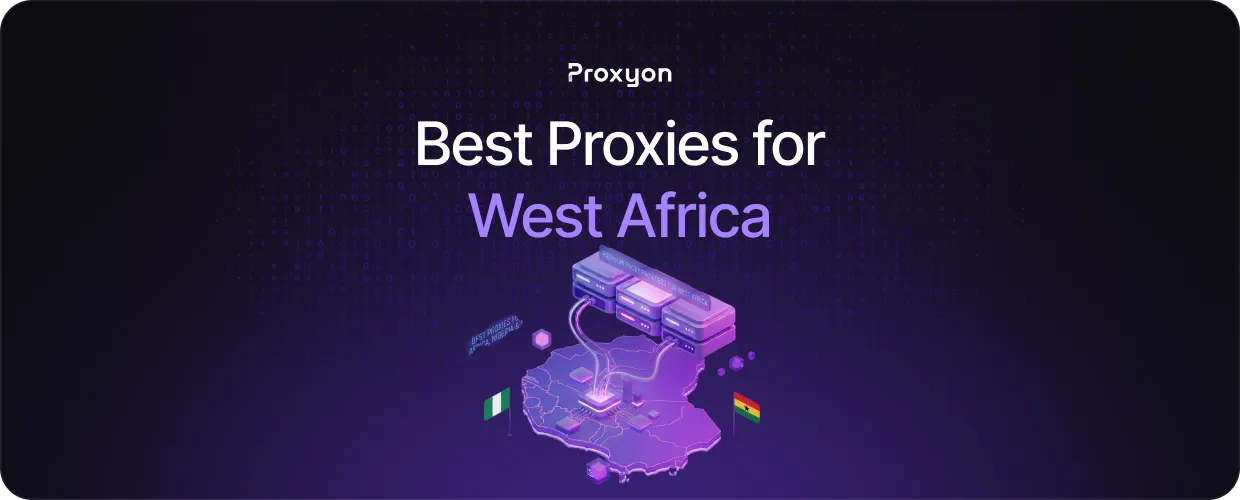
Getting a West African IP is harder than most people expect. Many providers either skip the region entirely or offer a handful of IPs that get flagged almost immediately. If you are scraping local e-commerce platforms, running ad verification, or doing market research across countries like Nigeria, Ghana, or Senegal, thin coverage will slow you down fast.
In this article, we'll explore the best proxy options for West Africa, what to look for in a provider, and how to get reliable coverage across the region.
What to Look for in a West Africa Proxy Provider
The first thing to check is the IP pool size for the specific countries you need. A provider might advertise global coverage but only have a few hundred IPs across the region, which means higher reuse rates and faster bans.
Beyond pool size, look at city-level targeting. Nigeria alone has major hubs like Lagos and Abuja that serve very different markets. Country-level targeting leaves precision on the table.
Reliability matters more here because network infrastructure varies significantly across West Africa. A provider routing traffic through European or Middle Eastern servers and calling it West African coverage will cost you blocks and latency. Residential proxies start at $1.75/GB with genuine city-level targeting across the region.
Also Read: Datacenter Proxies for Web Scraping
Best Proxy Types for West African Targets
Residential proxies are the strongest choice for most use cases. They use IPs assigned by local ISPs, blending in with regular traffic on Nigerian, Ghanaian, or Senegalese networks. If your target has any bot detection, residential is the safest option.
Datacenter proxies work for platforms without aggressive detection and are faster and cheaper. The issue specific to West Africa is that datacenter IPs from this region are scarce, so providers often reroute through nearby regions, introducing latency and geo-mismatch risks.
Mobile proxies use carrier-assigned IPs and are the hardest to block. They make sense for mobile-first platforms, which is a significant portion of West African web traffic. They cost more and are rarely necessary unless residential proxies are not cutting it.
For most use cases, residential proxies with city-level targeting are the practical starting point. See Proxyon's pricing page for a full breakdown.
How to Get Started with West African Proxies
Proxyon lets you deposit as little as $5 with no subscription and gives you instant access. Configure your requests to target the specific country and city you need. A Lagos residential IP will outperform a generic Nigerian one on a Lagos-based platform. Use WhatIsMyIPAddress to confirm your IP resolves to the correct location.
Pace your requests sensibly. If you hit blocks, switch proxy types before assuming the target is unscrapable. Residential proxies solve most issues, and mobile proxies handle the rest.
Also Read: What is ISP Proxy
Final Thoughts
Stick to residential proxies for most targets, fall back to datacenter for lighter ones, and use mobile only when needed. Proxyon covers all three with pay-as-you-go pricing starting at $1.75/GB. Deposit $5 and get started today.