


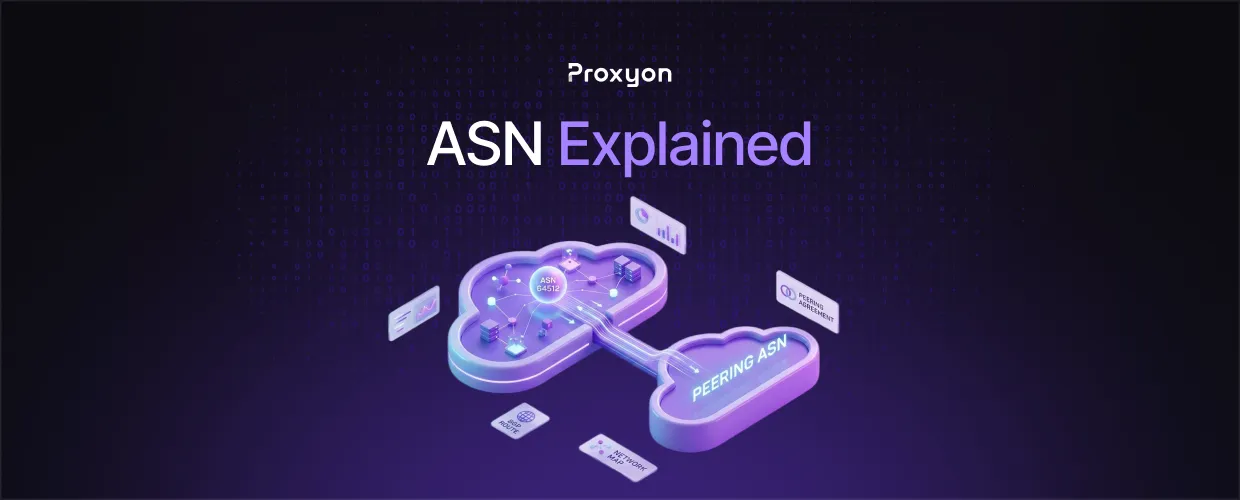
What Is an ASN and Why It Matters for Proxies
An ASN is assigned to an autonomous system, a network or group of networks managed under one routing policy. ISPs, cloud platforms, and large companies each run their own autonomous system, and each one gets its own ASN from a regional registry. ARIN defines an autonomous system as a group of IP prefixes run by one or more network operators that maintain a single, clearly defined routing policy.
Routers use ASNs to know which network owns which IP range. Cloudflare compares an autonomous system to a town post office that hands off mail until it reaches the right destination.
For proxy users, the ASN associated with an IP address is one of the first things a target site checks. A residential proxies connection routes through an ASN tied to a real household ISP, so it blends in with normal traffic. A datacenter proxies connection routes through an ASN publicly known to belong to a hosting company, making it easier to flag strict targets.
How ASNs Affect Proxy Detection
Fraud and bot detection tools do not just check if an IP is blocklisted. They check the ASN behind it. If that ASN belongs to a known hosting provider, the request gets treated as higher risk by default, regardless of behavior. The keyword here is trust by association: a site does not need to analyze your request pattern if your IP already sits inside a flagged ASN.
Also Read: What Does Scamalytics Do?
Looking Up an ASN

Every IP traces back to its ASN through a WHOIS or IP lookup tool. Checking this before buying proxies tells you whether the IPs sit inside a residential ISP range or a known data center range, which says more about real-world performance than price alone.
Also Read: What Is a Web Scraping Proxy and Why You Need One
FAQ Section
What does ASN stand for?
Autonomous System Number. It identifies a network operating under a single routing policy.
Who assigns ASNs?
Regional registries such as ARIN, RIPE NCC, and APNIC, on behalf of IANA.
Is an ASN the same as an IP address?
No. An IP identifies a single connection point. An ASN identifies the network that owns and routes a whole block of them.
Why do websites check ASNs for bot detection?
Because the ASN reveals whether an IP comes from a residential ISP or a data center, and data center ASNs carry far more automated traffic.
Can two IPs in the same ASN behave differently?
Yes. The ASN sets the baseline trust level, but request rate and behavior still matter.
How do I find the ASN behind a proxy IP?
Run it through a WHOIS or IP lookup tool. It returns the ASN, the owning organization, and whether the block is residential, hosting, or mobile.
Final Thoughts
Understanding ASNs comes down to understanding trust. Sites check who owns the network behind your IP before they check anything else. If you are getting blocked more than expected, the ASN behind your proxy pool is often why. Proxyon runs on pay-as-you-go pricing with no subscriptions, so you can test different ASNs and see what actually works for your target.